
Walder Foundation Announces 2026 Biota Awardees Advancing Approaches to Biodiversity Research and Solutions
Five postdoctoral scientists will advance research to protect and increase biodiversity in Chicago and beyond
CHICAGO, IL. — June 26, 2026 — Walder Foundation today announced the recipients of the 2026 Biota Awards, recognizing early-career postdoctoral scientists advancing research to better understand and conserve biodiversity across a range of ecosystems and geographies.
The Biota Awards support innovative research that addresses urgent questions about species, habitats, and the ecosystems that sustain them. The program emphasizes interdisciplinary approaches, collaboration, and projects that connect scientific insight with real-world conservation solutions.
Now in its fifth year, the program continues to support emerging leaders whose work spans urban ecosystems, marine systems, tropical forests, wetlands, plant conservation, and more.
“Biodiversity research requires both depth of expertise and connection to place,” said Elizabeth Walder, President and CEO of Walder Foundation. “This year’s Biota Awardees are advancing knowledge in ways that are grounded in local ecosystems while contributing to broader scientific understanding. Their work reflects the kind of thoughtful, field-based inquiry that is essential to addressing biodiversity loss.”
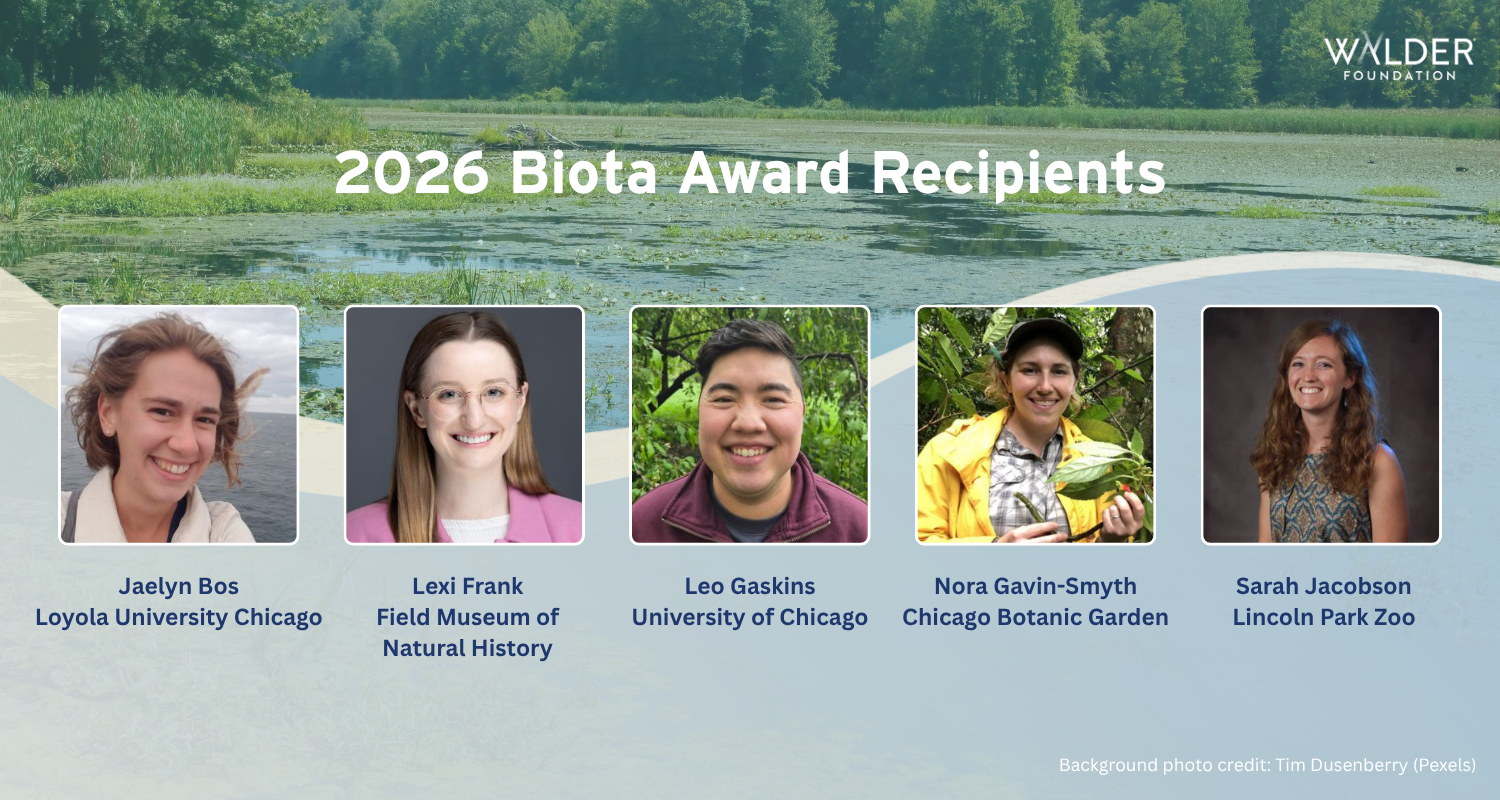
The 2026 Biota Awardees, all postdoctoral scientists, include:
Jaelyn Bos, Loyola University Chicago
Defining Coral Diversity to Guide Marine Conservation Planning in Mozambique
Mozambique’s coral reefs play a key role in supporting biodiversity and human well-being but remain understudied. This project will sample corals within a conservation area and use genetic sequencing to determine species diversity, rarity, and potential endemism to the region. The work also includes collaboration with university and NGO partners in Mozambique to build capacity for continued research.
Lexi Frank, Field Museum of Natural History
Bridging One Health Research and Traditional Ecological Knowledge to Understand Bat-associated Trypanosomes across a Human-modified Indigenous Landscape in Guyana
This project examines how land-use change and cultural practices influence bat diversity and the transmission of trypanosomes, parasites that cause neglected diseases such as Chagas disease. Working with the Waiwai Indigenous community, the research integrates biodiversity surveys, molecular analysis, and Traditional Ecological Knowledge to better understand connections among human, animal, and environmental health.
Leo Gaskins, University of Chicago
Using Muskrat Lodge Biomimicry to Improve Wetland Diversity and Bird Conservation
Muskrats act as ecosystem engineers, and data show significantly higher animal use of their lodges compared to surrounding wetlands. With muskrat populations declining, this project develops and tests mimic lodges to replicate these ecological effects. Through large-scale experiments and satellite analysis, it aims to improve wetland restoration and support conservation of regionally declining bird species.
Nora Gavin-Smyth, Chicago Botanic Garden
Developing Ex Situ Conservation Collections in Tanzania to Understand Speciation within a Megadiverse Genus
Focusing on the genus Impatiens, this project establishes conservation collections in Tanzania and Chicago to safeguard threatened species while studying how new species form. Research will examine reproductive isolation through controlled experiments and genomic analysis, while also strengthening conservation capacity in both regions.
Sarah Jacobson, Lincoln Park Zoo
Optimizing the Use of Contraceptive for Rat Control to Prevent Biodiversity Loss Caused by Rodenticide in Urban Ecosystems
To reduce reliance on rodenticides that harm non-target species, this project explores fertility control as an alternative approach to managing urban rat populations. By studying rat behavior and optimizing contraceptive delivery, the research aims to develop more humane methods that benefit urban biodiversity and public health.
Together, these projects reflect a growing need for research that not only advances scientific knowledge but also informs practical conservation strategies across diverse environments.
“The strength of this year’s cohort lies in how they connect rigorous science with real-world application,” said Jack Westwood, Senior Program Director, Environmental Sustainability at Walder Foundation. “From conservation solutions for corals in Mozambique and endangered plants in Tanzania, to research on biodiversity in Chicago’s post-industrial wetland complexes and preventing biodiversity loss associated with urban rats, these exceptional scientists are leading the way towards a more resilient planet for generations to come.”
The 2026 award recipients will be recognized at a celebration in the fall of 2026 hosted by Walder Foundation. To learn more about their research projects, please visit biotaawards.org.
Applications for the 2027 Biota Awards are now open. Similar to Biota Awards made in 2022-2024, the 2027 Biota Awards will support independent investigators based in Illinois institutions.
###
About Walder Foundation
Walder Foundation was established by Joseph and Elizabeth Walder to address critical issues impacting our world. The Foundation’s five areas of focus—science innovation, environmental sustainability, the performing arts, migration and immigrant communities, and Jewish life—are an extension of the Walders’ lifelong passions, interests, and their personal and professional experiences.
Walder Foundation’s Environmental Sustainability program promotes the long-term sustainability of the natural environment by addressing socio-environmental challenges to climate, water, food, and health.
Media Contact – Walder Foundation:
Elizabeth Kix, MPH, APR
Director of Communications
Walder Foundation
ekix@walderfoundation.org
847-616-5968