
CONTACT INFORMATION
Biota Awards Application Guide
2027 AWARDS FOR INDEPENDENT INVESTIGATORS
This guide contains instructions to complete an application for the 2027 Biota Awards, including document formatting and proposal guidelines. Please review the entire guide BEFORE beginning the application process.
Complete applications are due by 5 p.m. CT on October 8, 2026.
Informational Webinar
Walder Foundation staff provided an overview of Walder Foundation and its 2027 Biota Awards application opportunity on July 29, 2026. The webinar recording will be posted here soon.
OVERVIEW
This program aims to build the field of applied biodiversity and conservation science in the Chicago region and improve evidence-based conservation efforts.
The Biota Awards for Independent Investigators support exceptional early-career researchers (“Research Leads”) at institutions in Illinois who are conducting actionable biodiversity research designed to inform and/or improve on-the-ground conservation decisions, practices, or outcomes.
Projects should connect rigorous scientific research with real‑world conservation needs and be developed through active engagement with practitioners, land and resource managers, communities, agencies, and/or policy actors. They should generate credible, actionable knowledge and/or tools for conservation efforts and include training and/or capacity building efforts to broaden the research's impact.
This program is intended for Research Leads who are early in their independent research careers — within seven years of their first independent appointment but not yet tenured. They may be based in academic, non-profit, government, or hybrid research settings.
Awards are three-year research grants with funding granted to host institutions (“Grantee Organizations”) rather than individual researchers. Grantee Organizations will receive $300,000 of research funding distributed over three years. The geographic focus of the research is not restricted; however, all projects must have a meaningful connection to the Chicago region. This connection may be through an organization based in the region, the focus of the work itself, or how the project engages with Chicago-region communities, organizations, students, and other researchers.
For Research Leads at Chicago region* institutions: The geographic focus of the research is not restricted, and projects may focus on biodiversity and conservation topics relevant to the Chicago region or elsewhere; for example, biodiversity hotspots and/or the Global South.
For Research Leads at Illinois institutions outside of the Chicago region* (e.g. University of Illinois Urbana Champaign or Illinois State University): The geographic focus of the research and intended outcomes must be in the Chicago region.
In all cases, applicants should show how proposed action pathways and training efforts reinforce meaningful engagement with the Chicago region, even when conservation outcomes are expected to occur elsewhere.
Finally, Research Leads will join the Biota Awardee Network and participate in regular workshops, trainings, and professional development opportunities designed to build community and enhance key skills such as communication and mentorship.
*The Chicago region is defined as the Illinois parts of the Chicago Metropolitan Statistical Area according to the United States Census Bureau.
-
By the Grant start date (i.e., no later than November 30, 2027), the Research Lead selected for the award must:
Hold a Ph.D. or equivalent degree or experience. Equivalent experience might be a Master’s degree combined with several years of work as an independent researcher and/or a strong research track record.
Be employed by, or formerly affiliated with, an Illinois-based academic, nonprofit, or government research institution that is a governmental unit or a registered Section 501(c)3, 509(a)(1), or 509(a)(2) public charity or is working with a fiscal sponsor that meets these requirements.
Be within seven years of their first independent research position at an academic, nonprofit, or government research institution as of January 1, 2027. That is, they began their first independent research position no earlier than January 1, 2020. Walder Foundation may consider a special exception in certain circumstances, specifically for family or medical leave. Contact us for special exception approval.
Be an independent researcher leading research projects similar to how faculty-level principal investigators work in a university setting. This means that, in their current role, they independently design and lead research programs, either individually or as part of a research group they direct. A common indicator is that they typically serve — or would be expected to serve — as the corresponding author on research publications resulting from work conducted in their current role. Applicants are encouraged to use the personal statement section of the application to explain how criteria is met.
In addition:
Researchers employed at an institution who have already received tenure as of October 8, 2026 are not eligible.
Proposals must be submitted by a single principal investigator as the Research Lead but may include collaborators at the same or different institutions. Grants will be made to a single institution. Collaborations between Chicago-area institutions, and those that help to build research and conservation capacity in key geographies, are encouraged.
There is no limit on the number of applications submitted by an institution, but the Foundation will not make more than two awards to the same institution.
Research Leads must remain at the Grantee Organization for the three-year award period, and in most cases, funding is not portable. If a recipient moves from one Chicago-based institution to another, Walder Foundation may consider a special exception; however, in all cases, the institution must agree to any such change.
The Foundation is pursuing efforts to build community among funded researchers. The Research Lead should make every reasonable effort to attend Biota Awards convenings held by Walder Foundation to share progress on the work funded through this program, including the celebration event likely to be held in Fall 2027.
-
Application opens: JUNE 1, 2026
Application closes: OCTOBER 8, 2026, AT 5 P.M. CT
Applicants notified: MARCH 2027
Grants distributed: BY APRIL 2027
Biota Awards Celebration Event: FALL 2027
Grants expended by: APRIL 2030
-
Walder Foundation seeks proposals in all areas of biodiversity and conservation science, from the molecular to landscape scale, that address a clearly articulated conservation challenge. Projects must have a strong scientific component combined with a clear pathway to deliver on-the-ground results.
We are interested in the development and application of interdisciplinary projects with potential to bridge academic research and conservation practice, developing evidence-based, durable solutions to conservation challenges. Approaches should contribute to understanding, protecting, and restoring biodiversity by elevating research outcomes that have potential to deliver on-the-ground results or by developing new tools/methodologies for conservation and biodiversity monitoring. This might also include community and participatory science, and/or incorporation/application of Traditional Ecological Knowledge.
We recognize that outcomes may emerge over different timeframes and scales. Strong proposals will demonstrate clear intention and accountability in linking research to action, whether through near‑term implementation, decision‑support, or longer‑term improvements in conservation practice or policy.
Examples of strong action pathways include, but are not limited to:
Research questions and methods co-developed with conservation practitioners with a clearly defined approach for how findings will inform management, policy, or practice
Development of tools, technologies, frameworks, monitoring approaches, or datasets intended for clearly defined users, with a plan for how they will be tested, integrated, or adopted into existing processes
Research embedded within active conservation programs where results will directly inform conservation action or resource allocation
Projects that build evidence to evaluate existing conservation interventions, strategies, or policies with a clear plan for communicating findings to relevant stakeholders
Community-engaged and participatory research that elevates local knowledge, builds trust, and results in meaningful, community-defined outcomes for conservation, stewardship, and sustainable livelihoods
We strongly encourage Research Leads to partner with conservation organizations, practitioners, and/or other community stakeholders to ensure the proposed research reflects end-user needs, perspectives, and priorities and maximizes the potential for on-the-ground outcomes.
Research Leads are also expected to demonstrate how they will help build the field of applied conservation research by active leadership or participation in the training/mentorship of the next generation of biodiversity scientists and conservation leaders through internships, undergraduate research projects, and/or other opportunities that are well integrated and aligned with project goals.
E-mail us with questions or to confirm your eligibility.
-
Applications will be reviewed by an expert Advisory Committee of leading scientists and practitioners, with final funding decisions made by the Foundation. Proposals will be assessed according to the following criteria:
Research plan: The extent to which the project addresses a significant gap or clearly-articulated need for biodiversity and conservation science and demonstrates the necessary access to expertise and resources to make the project successful
On-the-ground impact: The extent to which the project has potential to result in meaningful on-the-ground impact and commitment of the applicant to realize this
Connection to Chicago: The extent to which the project has a meaningful connection to the Chicago region; even for projects with a global focus, we are interested in how Chicago-based stakeholders and communities might be connected to the work (e.g. through student participation and/or outreach)
Leadership: The extent to which the Research Lead is a current or potential future leader in biodiversity science and its application
Training and capacity building: The extent to which the Research Lead and proposed work contribute to building the biodiversity research and applied conservation science community by providing opportunities to train next- generation leaders and build research and/or conservation capacity; this work should be well-integrated into the overall project
Feedback received from reviewers is used by the Foundation, along with other factors, to make funding decisions. When selecting the final cohort of awardees, other factors taken into account may include alignment with the goals of the Foundation and the awards program, breadth of topics addressed, and approaches employed.
-
Request Overview
Project title
Request amount
How did you hear about the Biota Awards?
As of January 1, 2027, how many years of cumulative experience as an independent investigator will you have?
Website for applicant or research group (optional)
Geographic focus of research (select from the drop-down list)
Executive summary (up to 1,500 characters)
Goals (3-5 goals for proposed research by the end of the grant period)
Applicant Organization Information
Legal name
Tax ID (EIN)
Mission
Year founded
Address
Phone
Month and day of fiscal year end
Organization budget
Website
Social media handles for researcher (Facebook, Instagram, LinkedIn, YouTube, BlueSky, X) (optional)
Your Contact Information
Name, including preferred name
Pronouns
Title
Department
Address
Phone
Email
ORCiD ID (optional)
Contact information, including name, preferred name, pronouns, email, phone, title, department, and address for the following:
Grant agreement contact at Grantee Organization to review/sign the agreement
Payment contact for grant payments
-
In addition to the online form, the application includes documents which need to be uploaded to akoyaGO (see Document Formatting and Guidelines section) as detailed below.
The following should be uploaded to your application:
Research proposal
Budget narrative
Line-item budget
Research Lead’s Curriculum Vitae (CV)
Training, capacity building, and engagement plan
Personal statement
Letter of recommendation from grantee organization
Two letters of reference
Letter(s) of support from partner organizations
-
The research proposal, budget narrative, and personal statement must follow the formatting guidelines. Files must be saved as Word documents or PDFs, except the line-item budget which should use the Excel template provided below.
Documents should be formatted as follows:
Arial, Calibri, or Times New Roman font
11-point font or larger
At least 0.5” margins on all sides
Single-spacing
Standard character spacing (neither expanded nor condensed)
For any Excel documents you upload, please be sure to format so that all columns are visible on one page when printing or converting to pdf.
Documents should NOT be password-protected.
Documents that do not adhere to these restrictions may not be reviewed.
RESEARCH PROPOSAL (up to 8 pages excluding citations)
The page limits noted below serve as guidelines for the individual sections. The entire research proposal should not exceed eight pages, excluding works cited.Project Background (~2 pages)
Describe the background and previous work that has led to this project. Explain why this research is needed, the specific conservation challenge(s) you wish to solve, and the solutions that the work aims to provide. Describe how you have engaged the potential ‘end-users’ (e.g. conservation organizations, land managers, communities) of your research in problem definition and project design.Project Aims and Objectives (~1-1.5 pages)
Describe the specific goals of the project and specify any hypotheses that will be tested. If applicable, briefly present any relevant preliminary data. Describe the goals for translating the research into potential solutions and on-the-ground outcomes.Project Design, Approach, and Timeline (~2 pages)
Describe your planned approach, study design, and research methods for the specific project aims and objectives, including key milestones, as well as any supporting services (e.g., community engagement) you may need to complete your work. If applicable, outline any key dependencies between activities or interim milestones that will influence project decisions or directions. Describe elements of your project design that will ensure that your work will result in on-the-ground outcomes.Action Pathways (~1-2 pages)
Describe the ways that this research is actionable and how you expect this project to inform and result in on-the-ground conservation practices, decisions, or other outcomes in both the near- and long-term. On-the-ground outcomes are broadly defined and may include any activities that have meaningful impact on protecting, restoring, and conserving biodiversity, including policy and implementation of adaptive land management and improved conservation practices.Describe how will you communicate the results of your project, the audiences and communities you aim to engage, and outreach activities you plan to participate in. Outline how these communities influenced your research plans and direction. Indicate the impact this work will have on the wider research and conservation community.
Collaborations (~0.5 page)
Describe the key collaborations and partnerships in this work and their roles. Please indicate whether specific partnerships are already established, identified but not established, or not yet established. Describe any plans for engaging and communicating with communities and/or stakeholders that will benefit from the work.Works Cited (not counted in the total 8-page limit)
List any published works cited in the project proposal. Citations should include all authors’ names, article/journal title (or preprint server name), book/article title, and publication year.BUDGET NARRATIVE (0.5-1 page)
Summarize the budget needs of the project. Include a description of any sub-grants/sub-contracts you are considering, naming any known organizations. Note: Sub-grant/subcontract budgets are informational only, as all such decisions are at the discretion of the Grantee Organization and will not be made by the Foundation. Indicate whether any other funding relevant to the project is committed or pending. Please note that a match is not required.Important details:
Awards are for a total of $300,000 over three years, including indirect costs of 15%.
Payments will be made in installments of $100,000 at the start of each of the three grant years covered by the award, subject to receiving an annual grant report.
Project costs do not have to be evenly distributed across the funding period, despite the regular cadence and amount of award distribution. If this is the case, provide justification in the narrative.
Eligible costs include but are not limited to:
salary support for the Research Lead (limited to 20% of their annual salary for any given year)
postdoctoral and/or graduate and undergraduate research assistants
travel
equipment
consumables
research services and other research costs
subgrants to partner organizations
LINE-ITEM BUDGET
DOWNLOAD the budget template. Instructions for completing the budget can be found in the first sheet of the Excel workbook. Please only complete sub-award budgets for sub-awards totaling over $50,000.APPLICANT’S CV
Provide an up-to-date CV.TRAINING, CAPACITY BUILDING, AND ENGAGEMENT PLAN (Up to 2 pages)
Describe how you will engage in training and capacity building efforts that advance the next generation of biodiversity scientists and applied conservation leaders, both in Chicago and in other geographies of interest. Explain who the primary beneficiaries of this work will be, what capacities and skills will be built, the form these efforts will take, and how they are integrated with your research and conservation objectives. Describe how these efforts contribute to strengthening the Chicago region’s role in applied conservation efforts locally and/or globally.PERSONAL STATEMENT (up to 2 pages)
Provide a personal statement that outlines your career trajectory and interest in the Biota Awards program. Use the following to frame your response:Describe your career to date, including challenges you have faced and key achievements
Explain how specific experiences in your career relate to the activities proposed in this project
Identify any specific experiences you seek or skills you wish to develop during this award that will help you achieve your professional goals
Provide examples of how you have demonstrated leadership and taken innovative approaches to your work and the results achieved, including any tangible examples of translating your research into conservation outcomes
Outline your vision for the future of the field, the role you wish to play in shaping it, and how this award will advance you towards your vision
LETTER OF RECOMMENDATION
Letters of recommendation should be from the Grantee Organization and signed by the Research Lead’s head of department or executive director. The letter should explain what resources the Grantee Organization will make available to the Research Lead and how the proposed project aligns with the organization’s mission.LETTERS OF REFERENCE (2)
Please provide two letters of reference that speak to the Research Lead’s suitability for leading this research. Letters should articulate the Research Lead’s unique qualities and highlight key aspects of their experience that indicate they are well-placed to translate research into conservation outcomes. Letters should be written by people who can speak to the Research Lead’s experience, skills, and commitment to the field, such as colleagues, former colleagues, partner organizations, and collaborators.LETTERS OF SUPPORT FROM PARTNER ORGANIZATION(S)
Letters of support should be from partner organizations with a significant role or interest in the work. Letters should describe the relationship between the partner organization and the Research Lead, the role the organization has played in developing the proposal and will play in the project, and the benefits the project will provide to their mission. If relevant, the letter should also describe any resources the organization is dedicating to the project. If you are unable to submit a letter of support from key partners, please include a short statement explaining why this was not possible.
-
A video abstract is a video recording up to five minutes in length where you provide an overview of your proposal:
Discuss your proposed work and the conservation challenge you seek to address and what motivated you to propose this project.
Describe the partners required to complete the work, the potential on-the-ground outcomes, and the work’s connection to the Chicago region.
Video abstracts should be submitted using the online platform, Hireflix.
Hireflix instructions:
Go to the Hireflix website.
Enter your name and email address and click Start Interview.
Check for an email from Hireflix with a unique link to record your video abstract. Be sure to check your spam folder if you don’t see the email in your inbox.
To begin, press Start Interview. You will first be prompted to confirm your video and audio settings.
Press Start Interview again to proceed to the video recording page. When you are ready begin recording by clicking Answer Question.
You may stop and view your recording and, if necessary, re-record your video as many times as you wish.
When you are ready to submit, click ‘Submit Answer’.
Video abstracts will not be used as part of the initial proposal review; they will be used later in the process to provide summaries of the proposed work for reviewers and Walder Foundation leadership.
Application Instructions
You will need to create an account in akoyaGO, Walder Foundation’s grants management system. To create an account, you will need your organization’s Employee Identification Number (EIN). If you already have an account, proceed to “Begin your Letter of Intent (LOI) application” below.
Click on the link below to access the grantee portal:
Walder Foundation Grantee Portal
If the link is not working, please copy/paste this text into your preferred web browser: “https://goapply2.akoyago.com/walderfoundation/application/2027BiotaAwards” into your preferred web browser.
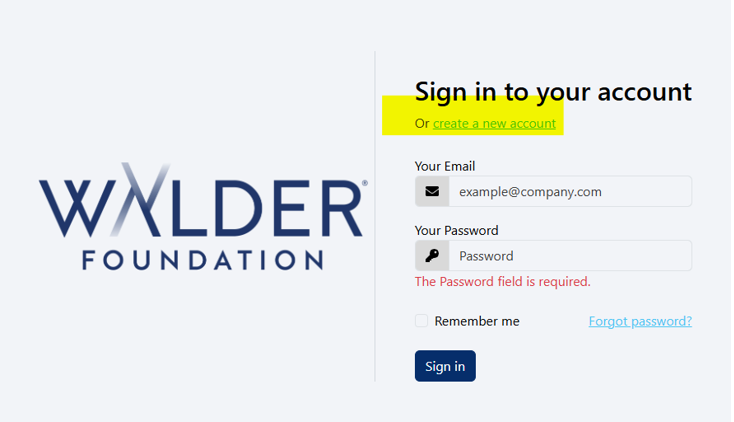
Choose “Or create a new account” (or sign in if you already have an account):
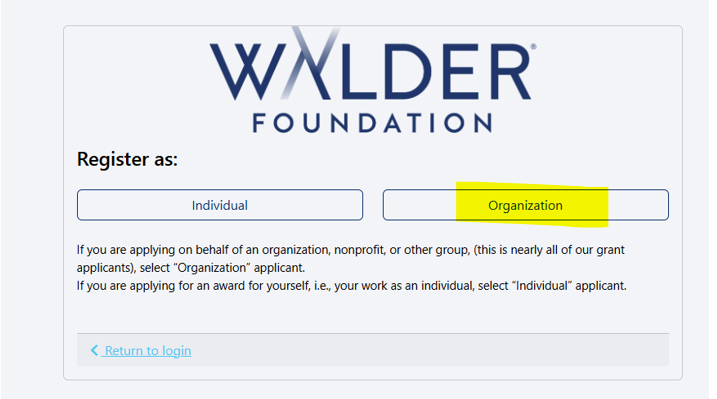
2. Select “Organization”
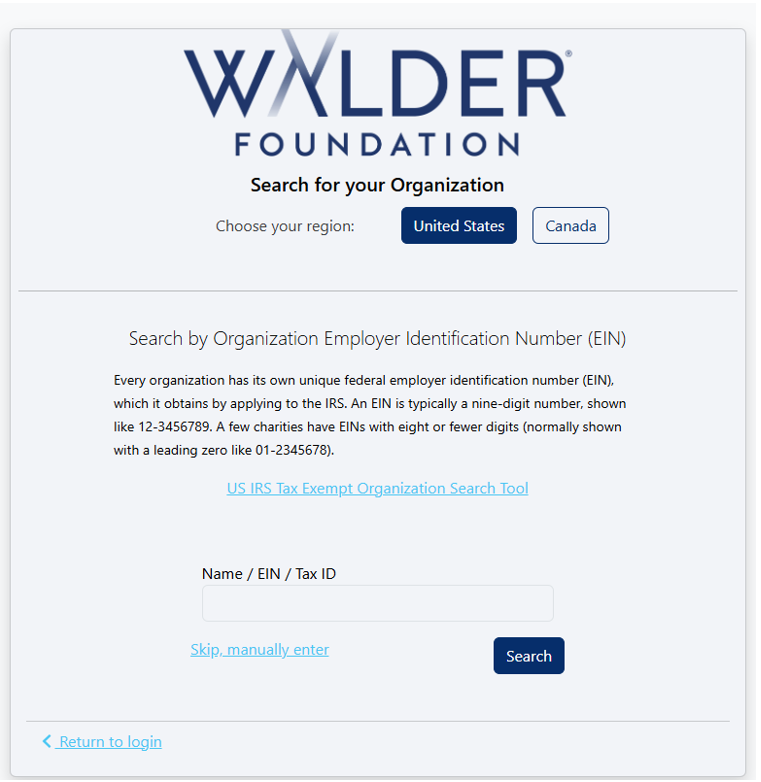
3. Choose your region – “United States” or “Canada” – and search for your organization using the Tax ID number. If your organization is outside of the United States or Canada, click on the link that says “Skip, manually enter” and input your organization’s information.
4. You will see a list of organizations matching that Tax ID number. It is possible that you see more than one entry for your organization, and it may have a staff member’s name following the organization name; for example, “Walder Foundation – Monica Chavez”. Click “Select” next to the entry for your organization that does not have a staff person’s name next to it.
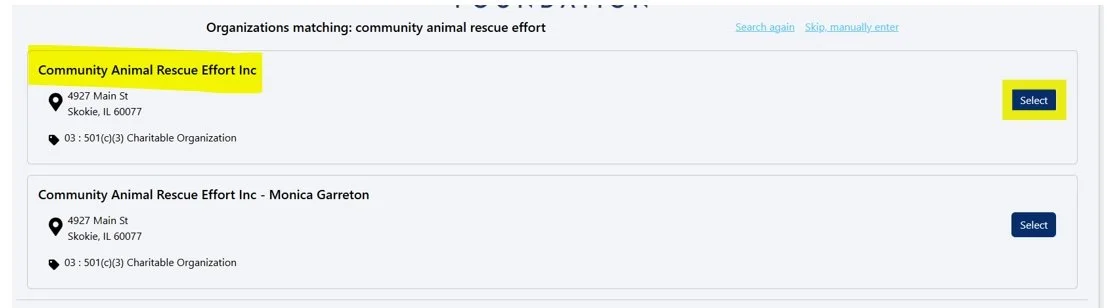
5. If your organization is new to our database and does not show up on the list, choose the “Skip, manually enter” option.
6. A screen will appear with fields you may fill out to create your new account.
7. Once you have completed the registration form and submitted it, your registration request will be reviewed. You will receive an email confirmation after it has been accepted, and you are free to access the grant portal. Please note that the process is typically completed quickly but may take up to two business days.
Begin your application
Once your user account has been accepted, use the link below to login and begin working on your application:
2027 Biota Awards Proposal Form
If the link is not working, please copy/paste this text you’re your preferred web browser: “https://goapply2.akoyago.com/walderfoundation/application/2027BiotaAwards”
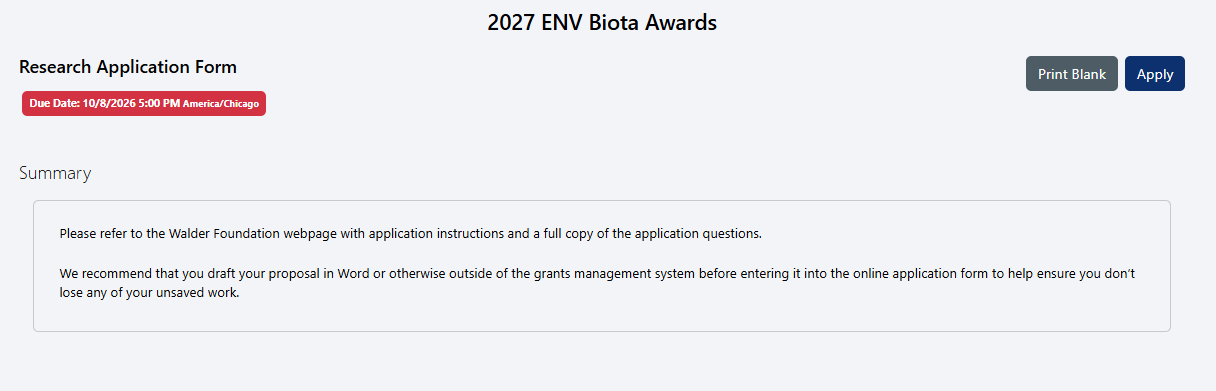
You will be able to log in anytime (up until the deadline) to work on your application and save your progress. We recommend creating your account early to familiarize yourself with the system and the application form.
>> VIEW A SAMPLE PROPOSAL FORM FOR COMPLETE REQUIREMENTS
An automated email confirmation is generated upon submission of the application. If you do not receive a confirmation within 24 hours of submitting your application, please check your spam folder and then contact grants@walderfoundation.org.
Applications must be submitted by 5 p.m. CT on October 8, 2026
For clarification about research priorities, eligibility, or scientific requirements, please contact biotaawards@walderfoundation.org.
For inquiries about the online application, please contact grants@walderfoundation.org.